Special characters are a silly way to make email subjects stand out

They’ve tried filling email subject lines with CAPITAL LETTERS and personalising them with your name. Now I’ve noticed a new tactic from email marketers looking to boost the open rates of their email campaigns.

It’s to make their messages stand out in your crowded inbox by including special characters like stars, hearts and smiley faces in subject lines. And at first glance, it works.

I bet you notice the special characters here:
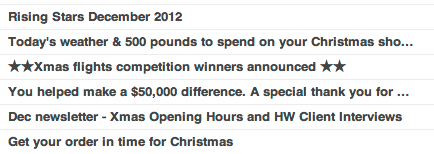
Email inbox

I’ve seen emails that use symbols representing the sun, an umbrella, a plane and more. There are lots of different symbols you can try and as statistics show they can help increase open rates, you can bet we’ll be seeing a lot more of them in the coming months.

But I’m not sure it’s a good idea to start using them willy-nilly in marketing emails. Here’s why:

  • Like using ALL CAPITALS TO SHOUT or grabbing attention with horrific blinking text, special characters seem a little impolite. They don’t show the reader much respect. They attract eyeballs but don’t add extra information in themselves.
  • It can be hard to get special characters to display properly across the wide range of software and services people use to receive email, adding extra complexity to your mailings. Broken emails just make you look silly.
  • The phenomenon of banner blindness means people don’t pay attention to things that look like adverts online. As special characters become more widespread, users may start to ignore them in the same way.

Besides all that, there’s the question of taste. Special characters can look a bit, well, cheap. Like trying to entice customers into a run-down shop by playing music outside, or hassling people in the street to try your restaurant, you need to think about the image you project.

Do you want to be part of the crowd that screams ever louder for attention, or would you rather invest your time in more subtle, nuanced ways of attracting and keeping customers?

First Great Western’s sticking plaster copy

Now, I’m no expert in running trains, but you might have gathered from previous posts that I’ve had the odd run-in with train company web design, signs and labelling.

In general, it’s fair to say I’m not a fan. And now I’ve found another piece of nasty sticking-plaster copy lurking on the First Great Western website:
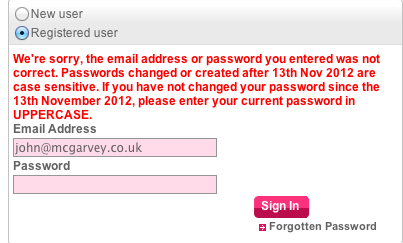
Screen Shot 2012-12-18 at 11.33.02

It seems the train company recently made its user password system case sensitive. In terms of security, this is a good move. But to accommodate the change, First Great Western decided to make everyone’s passwords all-uppercase.

If you don’t realise this when you try and sign in, you see this contrived error message:

We’re sorry, the email address or password you entered was not correct. Passwords changed or created after 13th Nov 2012 are case sensitive. If you have not changed your password since the 13th November 2012, please enter your current password in UPPERCASE.

The red text means it look like a serious error message, and it makes the user think they’ve done something wrong.

This is a classic example of a company making a well-intentioned technical change to its website, but forcing users to adapt to this change, rather than taking some extra steps to make life easier for them.

I call it ‘sticking plaster copy’ because it uses lengthy instructional copy to try and patch up the issue rather than fixing it properly.

Essentially, First Great Western has changed my password without asking. That’s inelegant and impolite. (It also raises the question of how securely user passwords are stored, but I’ll leave that issue to the technical experts.)

It makes my interaction with the website more awkward, adding an extra barrier that I have to overcome in order to buy a train ticket.

As an alternative, they could simply have allowed me to sign in as normal, then prompted me to change my password at a later point – perhaps immediately after signing in, or once I’d completed my purchase.

That would have made my life a bit easier, and it might even have positive impact on their website’s conversion rate too.

Saying sorry is no way to get started

Estate agent letter

I am not a fan of pushy estate agents. But if you are in that line of business, here’s some advice: if you’re going to go to the trouble of sending letters to home owners asking if they fancy renting their flats, don’t start by saying sorry.

Here are the first couple of lines from a letter that fell through my door recently:

“I apologise for this direct approach however we have seen a great demand this past summer with prospective tenants looking for properties like yours to rent.”

Even if you can disregard the questionable punctuation, admitting that your ‘direct approach’ may be inappropriate is hardly the best way to snag a new customer.

To anyone already put off by the impersonal letter, the apology simply confirms that the estate agent knows they should know better. And why apologise to anyone who actually doesn’t mind this out-of-the-blue communication?

There are many different ways to run a successful direct mail campaign, but opening your message with an apology is not one of them. If you’re confident your message is right for the people you’re sending it to, there’s no reason to say sorry.

Why more choice isn’t always a good thing

I’m a bit of a fan of Bristol-based Chemical, a self-proclaimed ‘music lifestyle store’ offering music, clothing, CDs, vinyl and more to its customers.

However, I’m not convinced the fashion-and-more retailer has quite got its online checkout process licked. Just have a look at this bemusing range of delivery options:

(See this image full-size in a new window.)

It reminds me slightly of the Trainline’s bonkers ticket selection screen, which I wrote about way back in 2007. In any case, the options presented are confusing and unnecessary, particularly if you want to get your order in a hurry.

With six next-day delivery options to choose from, how do you tell which is best? This comparison chart is less-than-helpful, because each of the options has exactly the same columns ticked.

Rule number one of creating an online checkout process is to keep it as simple as possible. Adding complexity makes it harder for people to complete their order, meaning fewer people manage to get to the end of the process.

Sure, it’s good to offer some choice of delivery options, but too much choice creates uncertainty: how do you know which is the best option for you?

I think Chemical would do well to chop their bemusing range of delivery services down to three: standard, guaranteed next-day and guaranteed Saturday. If they did, I bet they’d see a decrease in the number of visitors dropping out before completing their online orders.

Group buying: great or grating?

70 per cent off sign

I signed up to Groupon a couple of months ago. Everyone’s been talking about it (if by ‘everyone’ you mean the always-watching-for-the-next-big-thing Twitter crowd), so I thought I’d better give it a go.

A deal a day

The idea behind Groupon is simple and appealing. They send you a different deal each day. When you see one you like, you buy it. But the twist is in the ‘group’ nature of it. Each deal requires a certain number of people to commit to it. When it hits that number, the deal is on.

It’s all about harnessing group buying power to secure big discounts. ‘Up to 90 per cent discount,’ proclaims the site.

It works, but I don’t like it

Groupon works as a concept. It’s huge in the US. It’s been rumoured Google wants to buy the company. In short: it’s successful and people like it.

Yet something about the site has rubbed me up the wrong way. I think it’s all to do with the high proportion of beauty-related offers, and the super-low proportion of stuff I actually want to buy.

In the three months I’ve been signed up I haven’t clicked ‘buy now’ once. And yet my inbox has been crammed full of beauty-related offers that I find completely irrelevant. Here are a few samples:

Then there’s wrinkle reduction, next generation nails, reflexology – I could go on.

Enough is enough

I was promised great deals that I’d love. But I’ve ended up with a weird hotchpotch of beauty products, none of which are likely to ever appeal to me. As my email was overflowing with stuff I don’t want before I joined Groupon, I’ve decided enough is enough and have unsubscribed.

But I’m still intrigued by the concept. Am I just outside Groupon’s target market, or am I doing something wrong? Have you had a better experience? And if you’ve ever bought from the site, was it something you really wanted, or did you just click ‘buy’ because of the savings?

The most misleading banner ad ever?

If you’re looking for a decent, free image editing tool, but don’t need the expense of Photoshop or the complexity of GIMP, I can highly recommend Paint.NET.

However, if you plan on downloading this free software, stay sharp when you’re on the Paint.NET website. Because the link to download isn’t quite as obvious as it seems:

Download link

That big ‘DOWNLOAD’ button with the huge green arrow that drags your eyes in and won’t let go? That’s not it.

It is, in fact, an advert. It takes you to www.searchale.com, a site offering ‘the ultimate search tool’ – as far as I can tell, a toolbar you can download and use in your web browser.

I can’t find much other information about the company, apart from this complaint from someone who had the ad appear unexpectedly on their own website. So my advice would be to steer clear.

Oh, the actual download link? It’s up the top there, just beneath the logo:

Paint.NET download link

It’s not hard to see how SearchAle benefits from this advertising. I’m sure there are more people using its toolbar then there would have been otherwise.

I just wonder how many of those people actually wanted it, or even understood what they were downloading.

They’ve got it all backwards

Backwards clockFlicking through the careers page of The Guardian last weekend, I stumbled across an ad for a job with a company called Evitavonni.

“Hmmm,” I thought, “I’ve not heard of them before.” The name made me think that perhaps they were Italian, or maybe founded by someone called Evita. The look of the ad suggested some kind of design company.

Read it backwards

However, after studying the name a bit more, it hit me. Have you spotted it yet? The company is “innovative”, spelt backwards. Evitavonni. Innovative.

I’d love to know what process the company went through before coming up with that particular name. Because I’m struggling to see how backwards innovation can be a good thing.

A new trend in naming?

To me, writing a word backwards implies the opposite meaning. So by that token, Evitavonni suggests a business that’s old-fashioned, change-resistant and set it its ways. Doesn’t it?

Thing is, I don’t think they are. You certainly wouldn’t expect an uninnovative company to sell striking products like this expensive outdoor fireplace.

So, what gives? Why pick that particular name? Is backwards spelling a new trend in branding that’s yet to take off? (I can’t think of a single other company named in a similar way, though I’m happy to be corrected.)

Honestly, I’m stumped. But I do think if you’re going to pick a word and spell it backwards, you should at least choose one which will create a positive impression of your company.

Update: Since posting this, I’ve discovered there’s a good list of backwards brand names over at Fritinancy. I found it most interesting to learn that Trebor is the reverse of the company’s founder’s first name. Seems it’s not as uncommon as I thought.

Porn, pharmacies and phone sex. Who’s using the photos on your website?

It’s never been easier to find photos for your website. Pile-’em-high-sell-’em-cheap stock photography companies like iStockPhoto, Shutterstock and Fotolia allow you to purchase photos for as little as a pound or two.

These sites have drastically cut the cost of getting hold of images without worrying about copyright issues. I use them, so I should know. But there’s one big problem: when you pay so little, you don’t get any control over who else uses the photos.

Those images are sold again and again and again. Some of them are exceptionally popular – and that can spell embarrassment for your website.

I’ve trawled iStockPhoto – one of the biggest stock imagery sites – to bring you these five examples of stock photography that’s been rather, well, overexposed. If you’re looking for images to illustrate your website, steer well clear of these.

From web hosting to chief marketing officer

Lady with crossed arms

Plenty of websites seem to like the look of this lady. When she’s not urging you to “get more now” over at Midphase Hosting, she’s also putting in an appearance at Data102, a Colorado Springs hosting centre.

Then there’s marketing. She’s been standing in as a chief marketing officer for Brand Week – and been involved in this article about self branding. Busy lady.

A tired metaphor for growth

A tree growing in a hand

If you’re growing a business, here’s one visual metaphor you might want to steer clear of. It’s a very well-trodden path, you see. It might have been Clydesdale Ventures that first used this image. Or maybe it was Ian Brodie. Or Accelerate Media.

In hard copy, the books Recession Thriving and Trading Pain for Peace both have strikingly similar covers. Those green shoots of recovery are certainly spreading. Continue reading

Nice headline. Shame about the rest of the poster.

Here’s a poster I spotted stuck up in a station the other day. It’s an advert for an Oxfam fundraising event – a 100km, non-stop trek for charity. And I think the headline does the advert proud: “Blistering”.

It makes you want to know more, then as you read the rest of the text, the double meaning (is it about blistered feet, or the speedy pace of your trekking?) makes you smile.

And, of course, it grabs your attention. Or it would, if the dark green text on light green background, badly stuck up rippled paper and dodgy reflection on the glass didn’t render it all but unreadable from distance.

Honestly, what a waste of an excellent piece of copywriting. I get quite annoyed when I see good work treated this way.

The six perils of writing in public

You might have spotted from my previous posts that I like to work out and about. Cafes, pubs, bars … they’re all fair game for me and my little laptop.

I enjoy working on the move, but this very modern way of getting stuff done isn’t without its pitfalls.

Here are six situations to watch out for when it’s just you and your laptop:

  1. The lunchtime rush. At 10.30am, the cafe you’re in is nice and quiet. But at 11.30, something happens. The door doesn’t stop opening. People pile in, ordering take out or grabbing the last spare chairs. Nursing a small coffee while the world passes through, you feel conspicuous and in the way. Especially when some noisy office workers elbow their way to the table next to yours. Productive? You might as well give up now.
  2. The noisy children. These normally appear mid to late afternoon, though you can encounter babies and toddlers at any time of day. I’m undecided which is worse: the hyperactive ones who run about and push bits of furniture around, or the well-behaved, over-inquisitive ones who sit near you with their mum or dad and just won’t stop asking questions. Often about what the strange man with the computer is doing.
  3. The power crisis. Less than one cup of coffee into a stop at a café and my old laptop was gasping for juice. I constantly had my eye on the location of power sockets in the room, ready to shift tables when a prime spot became free. No matter what precautions I took, the machine would inevitably die during a highly productive spell. And have you ever had that awkward conversation when a member of café staff spots your unofficial power hook-up?
  4. The ergonomic nightmare. Starbucks chairs weren’t designed with the prevention of carpal tunnel syndrome in mind. In fact, they were probably designed to be uncomfortable to sit in for long periods, thus encouraging a fast customer turnover. (Ok, so maybe that’s just me being particularly cynical. But pay attention to what your body’s telling you. Wrists aching? Back sore? Time to find a proper desk.)
  5. The beer-on-tap temptation. One of my favourite spots to work is a bar/cafe just round the corner from my flat. The thing is, they have beer on tap. Good beer. A pint is ever-so-appealing, especially if I’m struggling with a tricky bit of work. I can usually resist the temptation, or postpone it by promising myself a glass when the job’s done, but every now and then (usually on a Friday afternoon) the pull is too strong.
  6. The toilet dilemma. Some cafés make you feel bad if you’re not constantly sipping while you work. With that much fluid intake, the inevitable tends to happen sooner rather than later. And that can lead to a difficult choice: do you pack everything up to guard against theft (in which case you might as well move venues), or trust the slightly shifty bloke on the next table to watch the laptop and papers you’ve spread out?

What obstacles have you faced when working out and about? Leave a comment and let me know.